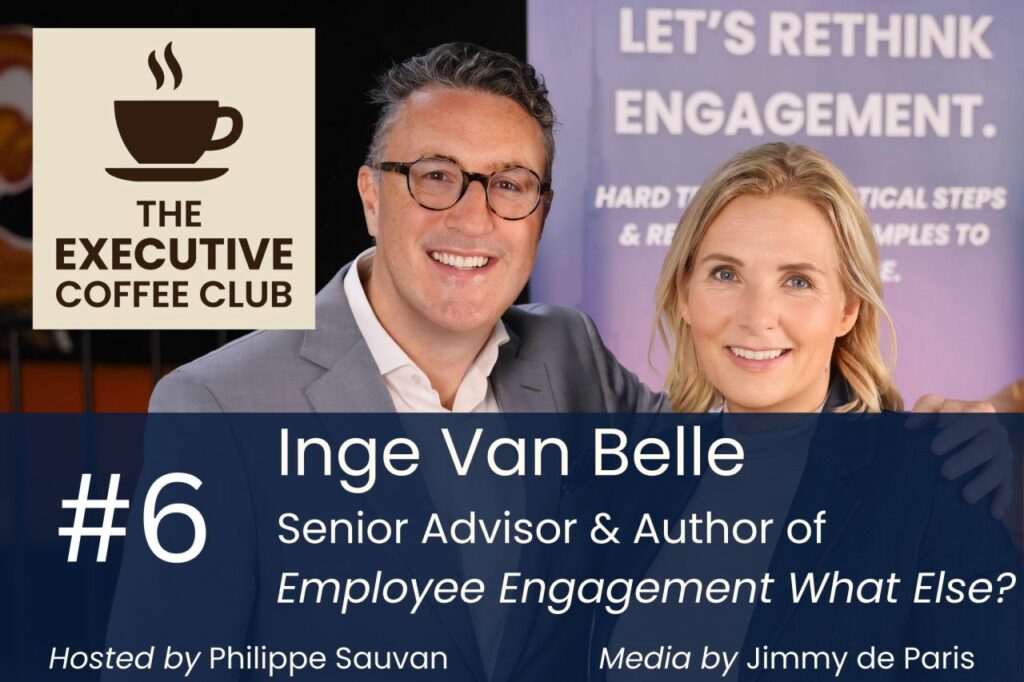
Reflections from the Executive Coffee Club
Recently, I had the pleasure of joining Philippe Sauvan on the Executive Coffee Club for a conversation about leadership, engagement and the shifts we are witnessing inside organisations today. Several themes surfaced during the discussion, but one pattern stood out clearly.

The Gap Between Intention and Execution
Across organisations, leaders are fully aware that engagement and culture are critical. In almost every executive team I work with, these topics rank among the top three strategic priorities. This is no longer a question of awareness or intent. The difficulty is operational.
Despite investments in programmes, surveys and communication initiatives, global engagement figures remain stubborn. Roughly 77 percent of employees are still not engaged. That number tells us something important. It is not a lack of effort. It is a lack of impact.
Many leaders are stuck between strategy and daily reality. They know what they want their culture to represent, yet they struggle to translate that vision into lived experience on the work floor. It is in that gap between intention and execution where engagement quietly erodes.
From Digital Leaders to AI Leaders
Another central theme of the conversation was the transition from digital leadership to AI leadership.
For years, strong digital leaders focused on speed, connectivity and innovation. Today, AI is embedded much deeper into organisations. It influences decision-making, processes and productivity. In many contexts, it is no longer just a tool. It is becoming a colleague.
The leaders who are most prepared for this shift show clear patterns. They are agile and strategically grounded. They collaborate naturally across silos. They make decisions informed by data while remaining open to change. They take intelligent risks without losing humility.
AI leadership requires ethical judgement, resilience under ambiguity, empathy and curiosity. Technology amplifies leadership. It does not compensate for its absence.
The more advanced the technology becomes, the more human leadership needs to be.
Engagement Cannot Be Manufactured
We also discussed a persistent misconception: Engagement cannot be engineered through isolated interventions. It cannot be delegated to HR and solved with a few leadership workshops or wellbeing initiatives.
Engagement is shaped by daily experience. It is influenced by clarity, trust and alignment. It is determined by whether leaders reward what they claim to value and whether tolerated behaviour quietly contradicts stated principles.
Systems and incentives will always outweigh beautifully written value statements. Culture becomes visible in what is rewarded, what is ignored and what is allowed to continue.
The UAE as a Leadership Laboratory
The context of the United Arab Emirates adds another layer of complexity to this discussion.
Few regions operate with such extraordinary diversity. Hundreds of nationalities collaborate daily, often within structures where a local minority holds senior leadership roles. The richness is undeniable. The complexity is equally real.
If engagement, trust and performance can be cultivated in this environment, they can be cultivated anywhere.
Rapid Fire Reflections
We ended the podcast with a rapid fire round. Short questions. Direct answers. But behind each answer sits years of observation.
1. One leadership habit that matters more than most people realise?
Ending conversations with clarity, not optimism.
2. One engagement myth you would like to see disappear?
That you can delegate it to HR and solve it with leadership training and wellbeing initiatives.
3. One mistake leaders keep repeating despite knowing better?
Overreliance on engagement scores, especially in this region.
4. One signal that tells you an organisation is healthy?
People speak up without checking who is in the room. And they are not afraid to fail.
5. One question every leader should ask themselves regularly?
“What am I currently rewarding without realising it?”
If you would like to watch the full episode of the Executive Coffee Club, you can find it here. My thanks to Philippe Sauvan for creating space for a real conversation, and to Jimmy De Paris for making it happen.