Fabrica
Creating moments that matter
More commitment from your employees thanks to the power of gamification and sportainment. Work hard. Play hard.
Well-being is a year, not a day.
Most companies in the UAE run a corporate well-being initiative once a year – a yoga session, a wellness day, a health screening at the office, a Step Challenge that lasts two weeks and is forgotten by the third.
That is not a well-being program. That is well-being theatre.
Real well-being is what happens between the events. The small daily decisions employees make about how they live, work and feel. A yoga session does not change those decisions. A 12-month program does.
We design 12-month well-being programs for organisations of 200 to 5,000 people. Monthly challenges, quarterly events, a year-end finale. All four dimensions of well-being – mental, physical, nutritional, social – integrated into one coherent journey, tracked on a platform built for it, and supported by a senior coaching ecosystem.
The result, measured against engagement and retention scores at the end of year one, is a different organisation than the one you started with.
Why most well-being programs fail.
Walk into any UAE company’s well-being initiative and you will see the same problem: it focuses on physical fitness, almost exclusively.
A 5K running club. A yoga session at lunch. A gym membership reimbursement. A step counter competition. Healthy snacks in the kitchen.
The data is uncomfortable: the employees who join these initiatives are mostly already healthy. The fitness-oriented employees show up; the people who actually need support do not.
Meanwhile, the three other dimensions of well-being — the dimensions where most burnout, attrition and disengagement actually happen — go untouched:
- Mental well-being. How employees deal with stress, information overload, personal growth, talent discovery, burnout prevention. Most often the dimension where breakdown starts.
- Nutritional well-being. What employees eat and drink, how it relates to energy and focus, how the company environment supports or undermines it. The simplest dimension to address — and the most overlooked.
- Social well-being. Relationships with colleagues, friends and family. Belonging. Connection. The overlap between individual values and organisational values. The dimension that determines whether someone stays.
A real well-being program integrates all four. Employees self-select which dimension they want to start with. Most people enter through one and gradually engage with the others as new habits form.
Twelve weeks is the established timeline for habit formation. Twelve months is the timeline for organisational change.
That is the program we run.
A year, structured.
Here is what a typical 12-month well-being program looks like with us:
Month 1 — Diagnosis and design. We work with you to map your starting point. Employee well-being survey (via Tornea, anonymised). Identification of your specific stress points, demographics, working patterns, language mix, religious considerations. From this, we co-design the program: which themes get which months, which Bravos coaches are involved, what the quarterly events look like.
Months 2 to 11 — The monthly rhythm. Each month focuses on one well-being theme rotated across the four dimensions. A typical sequence:
- January: Mental — stress and recovery
- February: Physical — movement at your pace
- March: Nutritional — fuel and energy
- April: Social — connection and belonging
- May: Quarterly event 1 — a one-day in-person well-being moment
- June: Mental — focus and attention
- July: Physical — sleep and rest
- August: Nutritional — hydration and habits
- September: Social — peer recognition
- October: Quarterly event 2 — a one-day in-person well-being moment
- November: Integration — applying the year
- December: Year-end finale — the apotheosis event
Each month is structured around small, repeatable actions employees can do at their desk, at home, or together with colleagues. Tornea tracks participation. Points accumulate. Stories are shared on the platform. Leaderboards run for those who like competition; quiet participation is fine for those who don’t.
The apotheosis event — December. The year closes with a full-day in-person finale, designed as an active festival, with eight challenges aligned to the four values, teams of 5-7 employees, awards ceremony, and a celebration of what the year produced. Not a competition — a recognition.
Year-end reporting. Two weeks after the finale, we deliver an impact report comparing baseline survey to year-end survey, with specific recommendations for year two.
Three real well-being deliveries. Three different organisations.
We have delivered well-being programs and events for organisations across Europe, MENA and beyond. Three that demonstrate how our methodology adapts across very different contexts — from a single inclusive Happiness Day to a full 12-month organisational program:
ACWA Power FIT DXB — Energy company, performance culture
ACWA Power is a global energy company with operations across the GCC. Their FIT DXB program is built around the integration of well-being into a high-performance corporate culture — recognising that sustainable performance requires recovery, balance and team connection.
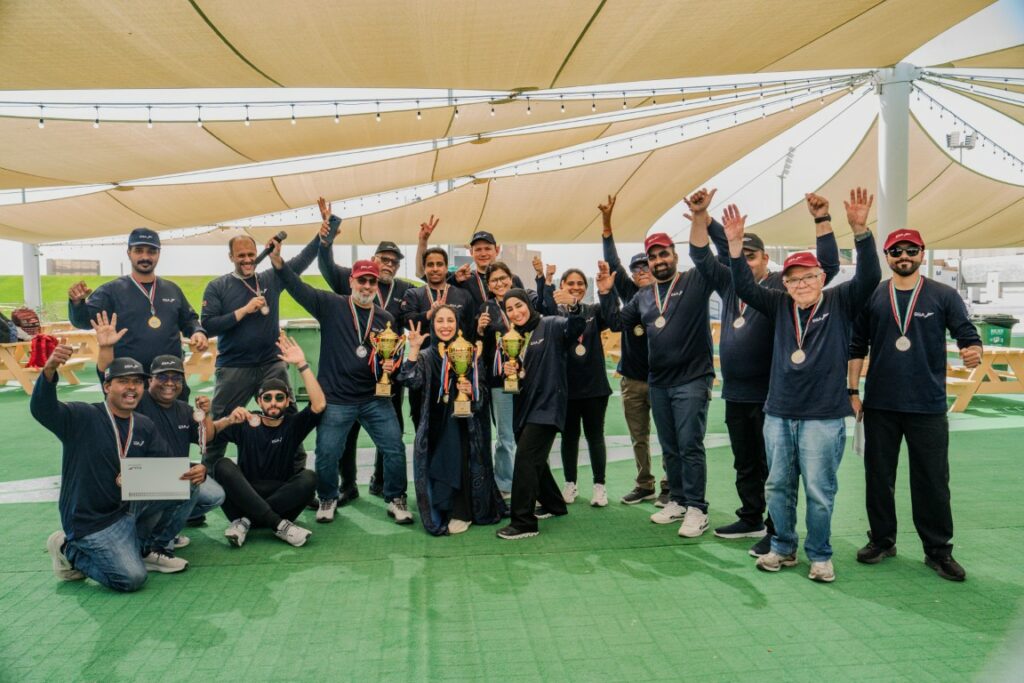
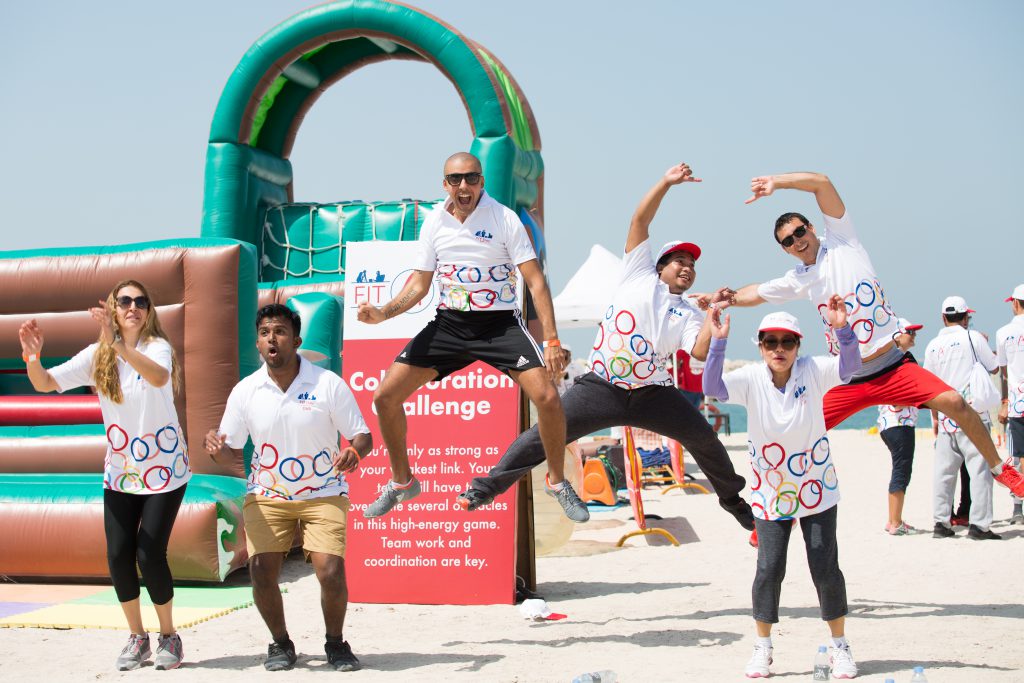
We delivered a well-being program ending in a full-day FIT DXB activation at Jebel Ali Resort: an afternoon of energising games and team competition, awards ceremony, and a celebration. The finale was the visible part. The 12-month foundation of monthly themes and platform engagement was the part that made it last.
Best for: high-performance organisations where well-being needs to integrate with – not replace – a results-driven culture.
ENOC Happiness Day — when the journey starts with one event
Sometimes a year-long well-being program starts with a single, well-designed day.
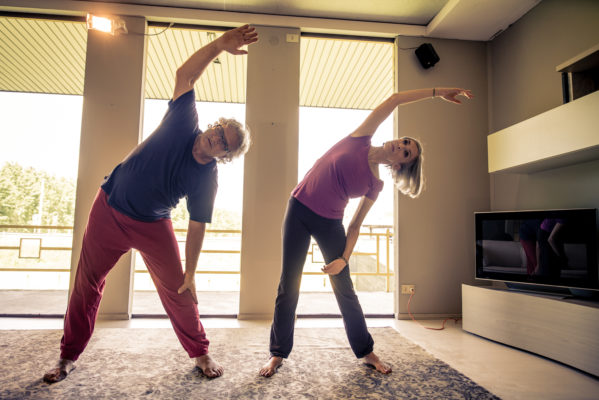
ENOC’s Shared Services division ran a Happiness Day for 200 employees at the Grand Hyatt Dubai, with the theme “Be Happy, Do Happy, Get Happy.” The morning combined well-being content with a Tai Chi movement session that set the tone for the rest of the day. The afternoon turned the Happiness theme into practice through six inclusive team challenges where athletic skill did not matter. Every member had a role to play. The day closed with medals for all participants and awards for winners, runners-up and fair play teams.
The feedback from Mohammad Zahoor, Head of Talent Development at ENOC: “Many thanks for conducting such a great event. I would love to bring you guys back to ENOC events in future. I have received excellent feedback from participants. A high 5 from the ENOC family.”
Best for: organisations testing the well-being concept before committing to a full year — a strong single-day event often becomes the trigger that opens the budget conversation for a longer program.
Provincie Vlaams-Brabant — Public-sector government, the methodology in full
The Provincie Vlaams-Brabant is a Belgian provincial government with thousands of employees across health, education, infrastructure and administration. They wanted to move beyond a once-every-two-years Day of the Personnel toward a continuous well-being journey.
We co-designed a 12-month program built around four objectives – Mental Balance, Physical Balance, Nutritional Balance, Social Balance – with employees self-selecting their starting dimension. Activities accumulated on the platform across the year. The Day of the Personnel itself was redesigned as the year’s finale: a sportive festival with 8 challenges directly mapped to the four values, teams of 5-7 employees, awards ceremony, and recognition.
The result became the methodology template we now use everywhere, including in the UAE.
Best for: organisations that want a complete, well-documented well-being program with measurable outcomes and a clear methodology behind it.
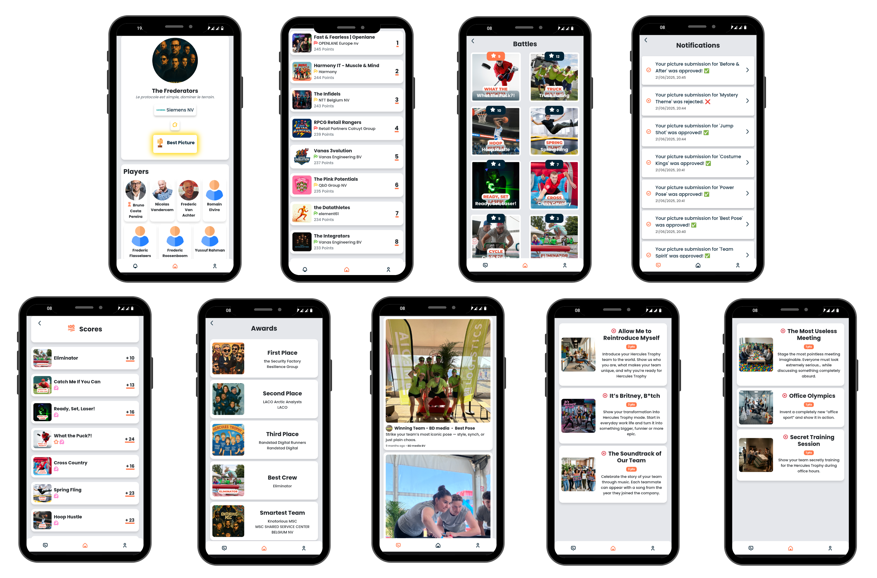
Tornea — the program’s spine.
A 12-month well-being program is impossible to run by spreadsheet and email.
Our engagement platform, Tornea, is the spine of the program — branded in your company colours, configured to your goals, available to every employee on any device.
What employees see on Tornea:
- Their personal monthly themes and challenges
- Their accumulating well-being points across the four dimensions
- Team leaderboards (optional, can be turned off for teams who prefer privacy)
- Articles, resources, and prompts from the Bravos coaches
- Registration for quarterly events and the year-end finale
- Anonymised baseline and follow-up surveys
What you see on Tornea:
- Participation rates by department, team, location
- Survey results compared baseline-to-current
What you do not see:
- Individual employee data (privacy by design)
Tornea is not a wearable. It is not a productivity tracker. It is a program platform built specifically for well-being journeys at organisational scale.
A program is only as good as the people who run it.
A 12-month well-being program is too long and too important to be delivered by an account manager and a junior facilitator.
For our well-being programs, we draw from the Bravos ecosystem. A curated network of senior coaches and specialists, each with deep expertise in one or more well-being dimensions:
- Inge Van Belle — methodology lead. Author of Employee Engagement, what else?, Vice Chair Benelux Business Council, ex Senior Client Partner Korn Ferry MEA. Designs program architecture and leads strategic content.
- Benoit Demeulemeester — founder of Endorphins Method UAE. Outdoor experiences, breathing techniques, ice baths, cold exposure protocols. Leads physical and mental resilience work.
- Carine Bouery — corporate happiness specialist. Integrates daily well-being practices into the working environment.
- Maud Gaspard — equine-guided experiential workshops. Used in select programs for deeper team work.
- Specialist contributors for nutrition, mindfulness, sleep science, and HR/policy integration depending on program needs.
- Yves Vekemans — architect of the Tornea platform and co-founder of Herculean Alliance who’s an expert in gamifcation.
You meet the coaches who will lead your program before signing. We do not bait-and-switch. We integrate.
Clear about scope.
A 12-month well-being program is for:
- Organisations of 100 to 5,000 employees
- Companies committed to engagement and retention outcomes, not optics
- Directors who have the budget and the mandate to run a year-long initiative
- Workforces that include a mix of physical activity levels, age groups, and cultural backgrounds
- Companies who measure engagement scores and want them to move
It is not for:
- Organisations looking for a one-day wellness event (we offer one-day formats — see our events overview)
- Companies who want to outsource well-being entirely (this requires internal sponsorship and HR partnership)
- Programs without budget commitment for the full 12 months (a half-program produces a half-result)
- Workforces dominated by single, young, fitness-oriented employees (consider a teambuilding instead)
If you are not sure where you fall, send us a note. We tell you straight.
Frequently asked questions.
How much does a 12-month well-being program cost?
Cost varies significantly with organisation size, scope of monthly themes, number of in-person events, and the specific coaches involved. We do not publish price lists because every program is custom-designed. The fastest way to get a real number is to send us your headcount, your objectives, and your budget range. We come back with a structured proposal within two weeks.
Can the program be shorter than 12 months?
Yes, we offer 6-month, 9-month and 12-month variants. The 12-month version produces the strongest measurable impact because it covers a full annual cycle (including seasonal moments like Ramadan, summer travel, year-end). Shorter programs work well as introductions or pilots.
How does Tornea handle employee privacy?
By design, individual employee data is never visible to anyone in the organisation — not HR, not management, not even Herculean Alliance. Aggregated and anonymised data is available at department, team and organisation levels. We are GDPR-compliant and hosted on Microsoft Azure UAE with full data protection in place.
What if our employees don’t engage?
Engagement is the central design challenge. We measure it from day one — participation rates by department, by demographic, by month. If a segment is not engaging, we adjust the communication for that segment (different themes, different communication, different coaching). Most programs land at 60-80% sustained monthly participation by month six.
Do we need internal champions or can you run it entirely externally?
Internal champions matter. A 12-month program needs at least one engaged internal sponsor (typically HR or the Wellness Officer) and ideally a small cross-functional team of champions across departments. We work alongside them. We do not replace them.
Can the program include Ramadan?
Yes. Ramadan is integrated into the program with a dedicated month focused on mindful eating, energy management, prayer and rest rhythms, family connection. We design Ramadan months in consultation with the client to honour religious practice while sustaining the well-being narrative.
How does this relate to ESG or sustainability reporting?
Well-being programs generate data that fits directly into ESG reporting under the S (Social) pillar — engagement scores, retention rates, employee wellness indicators, mental health support uptake. We provide structured year-end reports that align with major reporting frameworks.
What is the difference between this and a Leadership Retreat?
A Leadership Retreat is a senior team intervention. A Well-being Program is a 12-month organisation-wide initiative. The two are complementary: senior teams often launch the well-being program with a Leadership Retreat (to align around the year ahead), then participate in the program alongside the broader organisation.
Relevant Articles
Bravos Lab with Aqsa Khalifa on GenZ
Engagement In the UAE Doesn’t Collapse. It Erodes.
Bravos Resilience Lab launched
Inside the Bravos Lab of March 2026